About
Introduction to ISO 4593
ISO 4593 is the international standard that specifies a mechanical method for determining the thickness of plastic films and sheeting. Accurate thickness measurement is crucial for evaluating material quality, ensuring uniformity, and verifying compliance with product specifications. This standard is widely applied in the packaging, food, medical, pharmaceutical, and industrial film sectors, making it essential for professionals involved in quality control and product development.

Film Thickness Gauge
Film Thickness Tester: Measuring Thin Films Accurately
The film thickness tester is a primary instrument used to perform ISO 4593 testing. Using precise mechanical scanning, the device determines the thickness of film across the sample, ensuring reliable and reproducible results. Accurate thickness measurements help manufacturers optimize material usage, maintain consistency, and avoid issues such as packaging failure or product contamination.
Film Thickness Gauge
Applications of ISO 4593 in Material Testing
ISO 4593 is applicable to a wide range of plastic films and sheeting, excluding embossed surfaces. Common materials tested include:
- Polyethylene (PE) films for packaging and barrier layers
- Polypropylene (PP) films for flexible packaging and labels
- PET films used in medical or electronic applications
- Multilayer laminates used in food and pharmaceutical packaging
By implementing ISO 4593, manufacturers can confirm that each batch of film meets required tolerances, ensuring consistent performance in end-use applications.
Film Thickness Gauge
Benefits of Integrating ISO 4593 Testing in Quality Systems
Integrating ISO 4593 into routine quality control provides multiple benefits:
- Enhanced Consistency: Ensures uniform film thickness across production batches.
- Material Optimization: Prevents overuse of film while maintaining protective performance.
- Process Improvement: Identifies manufacturing deviations, enabling corrective actions.
- Regulatory Compliance: Supports adherence to industry standards and customer specifications.
- Flexible Food Packaging: By measuring PE and PP film thickness, manufacturers maintain airtight seals, extending shelf life.
- Medical Device Wrapping: Ensures that sterilization wraps have consistent barrier properties.
- Electronic Film Laminates: Controls insulation thickness to avoid overheating or electrical shorts.
Film Thickness Gauge
Case Examples of ISO 4593 in Practice
Thickness Measurement
ISO 4593 Test Procedure
The thin film measurement procedure is designed to ensure accurate results while preventing specimen deformation:
01
Clean both the test specimen and measuring device surfaces to remove dust or contaminants.
02
Check and set the zero point of the measuring device before testing. Recheck after each series of measurements to maintain accuracy.
03
Lower the measuring foot gently to avoid compressing the film. Mechanical scanning measures thickness at multiple points across the sample, producing a reliable average value.
04
Record and analyze the measurements, ensuring that variations fall within acceptable tolerances.
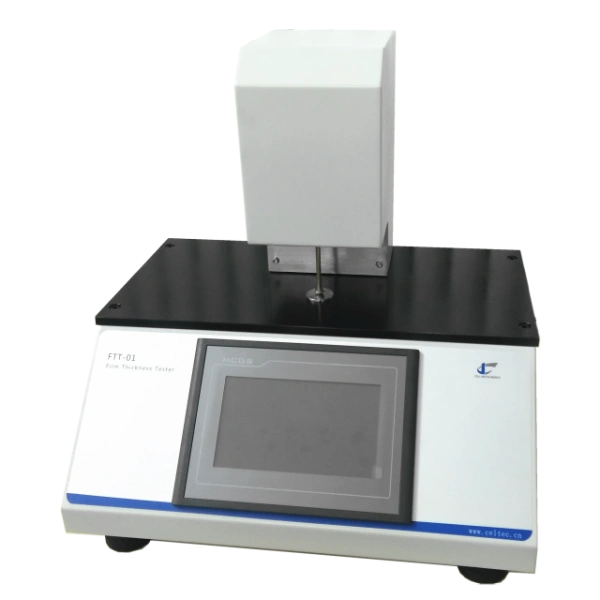
FTT-01 Thickness Tester
Recommended Equipment: Cell Instruments FTT-01
For professionals performing ISO 4593 testing, the Cell Instruments FTT-01 film thickness tester offers unparalleled precision and efficiency. Its advanced mechanical scanning system provides accurate measurements of the thickness of film across various materials, including PE, PP, PET, and multilayer laminates. The FTT-01 combines ease of use with high accuracy, making it ideal for R&D, production quality control, and compliance verification.
For businesses seeking high-precision, reliable film thickness measurement, Cell Instruments offers the FTT-01 Thickness Tester. This equipment is designed for:
- Measuring plastic films, paper, foils, textiles, and membranes.
- Providing 0.1 μm resolution for precise measurement.
- Offering statistical analysis, including max, min, average, and standard deviation.
- Supporting both manual and automatic feeding options.
- Delivering data storage and optional software connectivity for process integration.
By implementing the FTT-01, manufacturers can enhance quality control, improve production efficiency, and meet international standards.
Advantages of Using FTT-01 for ISO 4593
- High Accuracy: Mechanical scanning ensures minimal deviation in measurements.
- Versatility: Supports a wide range of film types and thicknesses.
- Efficient Testing: Automated averaging and multiple-point scanning reduce testing time.
- Professional Support: Cell Instruments provides calibration, training, and maintenance services to ensure consistent performance.
"Choosing Cell Instruments means working with a company that specializes in innovative material testing solutions. With years of expertise, we serve industries ranging from packaging and food to medical, pharmaceuticals, textiles, and electronics."
– Cell Instruments
Frequently Asked Questions about Film Thickness Gauges & Equipment
Q1: What is ISO 4593 used for?
ISO 4593 specifies a method to measure the thickness of plastic films or sheets using mechanical scanning. It ensures consistent material quality and is widely applied in packaging, electronics, and medical device industries.
Q2: Which materials can be tested with ISO 4593?
This standard is suitable for flat, unembossed films made of plastics such as PE, PP, PET, and laminated structures. It is not applicable to embossed films or materials with surface irregularities.
Q3: Why is measuring film thickness important?
Accurate thin film measurement ensures uniform mechanical and barrier properties, reduces material waste, and supports regulatory compliance. Variations in thickness can affect sealing performance, tensile strength, and overall product reliability.
Q4: Which instrument is recommended for ISO 4593 testing?
The Cell Instruments FTT-01 Film Thickness Tester is an excellent choice, offering precise mechanical scanning, easy operation, and reliable repeatability for various plastic films.
 English
  Arabic
  Bulgarian
  Czech
Czech  Danish
  German
  Greek
Greek  Spanish
  Estonian
  Finnish
  French
  Hungarian
  Indonesian
  Italian
  Japanese
  Korean
  Lithuanian
  Latvian
  Norwegian
  Dutch
Dutch  Polish
  Portuguese
  Romanian
  Russian
  Slovak
  Slovenian
  Swedish
  Turkish
  Ukrainian